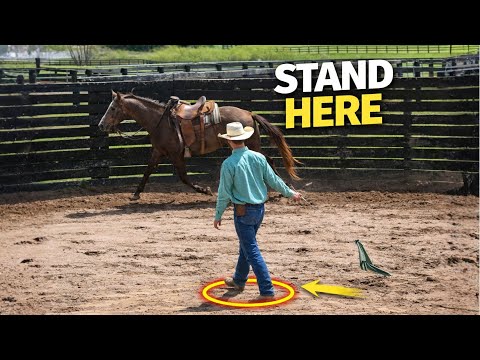
The round pen is essentially a laboratory for body position communication — a contained space where the handler can experiment with how different body positions, orientations, and movement patterns affect the horse's speed, direction, and emotional state without the complication of a lead rope. The horse's responses in the round pen are direct, unfiltered feedback on the quality of the handler's body position communication.
In round pen work, the handler's position on the circle relative to the horse determines what message is being sent. Standing at the horse's girth line — directly to the side of the horse as it travels — is a neutral driving position that maintains the horse's forward movement without accelerating it. Moving ahead of the girth line toward the horse's head shifts the pressure to a blocking position that slows or stops the horse or creates a direction change. Falling behind the girth line toward the hindquarters shifts the pressure to a driving position that increases forward energy.
The size of the handler's presence — how much space they take up through expanded posture, raised arms, or active movement — also communicates intensity. A handler who moves actively, makes themselves large, and maintains direct engagement with the horse's driving zone creates strong pressure. A handler who becomes still, makes themselves small, drops their gaze, and opens their body posture creates a rest or draw moment that the horse can recognize as an invitation to decelerate and orient toward them.
The most common mistake in round pen body position is unconscious inconsistency — the handler's position drifts relative to the horse without awareness, sometimes creating driving pressure and sometimes creating blocking pressure without intending either. The horse responds to what the handler's body is actually doing rather than what the handler intends to do, which means that developing conscious, deliberate control of body position is the primary skill for effective round pen work.