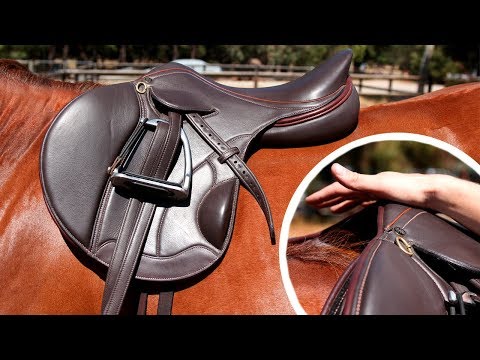
The rider's position and seat are the foundation of effective communication with the horse — every aid, every cue, and every correction flows through the quality of the rider's position, and a position that is unbalanced, tense, or inconsistent produces unintended signals that interfere with training regardless of how correctly the aids are applied in theory. A correct, independent seat — one that follows the horse's motion without gripping, bracing, or relying on the reins for balance — allows the rider to apply specific, deliberate aids and release them completely, which is the condition required for clear communication. Developing a correct position takes years of deliberate practice, often with specific exercises to address the most common postural problems: tipping forward, collapsing the hip, gripping with the knee, stiffening the lower back, and holding the breath. The answers below address position and seat development for western and English riders, covering the specific problems that limit effective communication and the exercises that build the independent, following position that every discipline rewards.
All Questions
32 answersQ 01 of 32
How does where I look affect my horse's direction and balance?
Where a rider looks is one of the most underappreciated influences on a horse's movement, and it is also one of the easiest corrections to make once a rider understands the mechanism. The connection between the rider's eyes and the horse's direction is not mystical — it is biomechanical. Where…
Read full answer →Q 02 of 32
When galloping some folks tend to get too far forward and perch with their butts not in the saddle. What do you think about this?
Perching at the gallop is one of the most common position faults in western riding and it creates a cascade of problems that most riders don't even connect back to their seat. When you come up out of the saddle and tip forward, you shift your weight onto the horse's…
Read full answer →Q 03 of 32
Is it a good idea to bury your boot in the stirrup when galloping or what should you do?
Burying your boot in the stirrup — pushing your foot all the way through so the stirrup is back at your arch or heel — is a habit that creates more problems than it solves, and it's surprisingly common among western riders who think they're securing themselves. The logic seems…
Read full answer →Q 04 of 32
How about riding with no stirrups to learn balance and help with perching?
Riding without stirrups is one of the oldest and most effective training tools in horsemanship, and there's a reason every serious riding program from western performance to dressage to hunt seat uses it. When you take the stirrups away, you eliminate the rider's ability to stand up, grip down, or…
Read full answer →Q 05 of 32
How do I learn diagonals?
Learning diagonals is one of the first genuinely technical riding skills that new trot riders encounter, and it is one of those skills that feels impossibly abstract in the first few lessons and then suddenly clicks into a pattern that becomes automatic within a few weeks of consistent practice. Getting…
Read full answer →Q 06 of 32
What are the key points to using spurs correctly for western horses?
Spurs are one of the most misused pieces of equipment in western riding, and the misuse almost always runs in the same direction — too much, too soon, too often, and without the stable leg position required to make them a precise communication tool rather than a source of random,…
Read full answer →Q 07 of 32
When should you start wearing spurs on a young horse in training?
The question of when to introduce spurs on a young horse deserves more careful thought than it typically receives, because spurs are introduced too early far more often than they are introduced too late, and the consequences of premature spur use are more damaging and more difficult to correct than…
Read full answer →Q 08 of 32
How does my sitting position affect my horse's ability to stop?
The connection between rider position and a horse's stopping ability is more direct than most riders realize, and poor position at the stop is one of the most common reasons a horse that stops well in training fails to deliver that same stop under pressure or in competition. The horse's…
Read full answer →Q 09 of 32
What is a good use for a riding crop?
A riding crop is a legitimate and useful training tool when its purpose is understood correctly and its use is applied with the timing and restraint that make any training aid effective. The crop is not a punishment device, not a substitute for correct leg aids, and not a tool…
Read full answer →Q 10 of 32
How do I improve my balance at a trot?
Improving balance at the trot is one of the most foundational challenges in riding development. The trot is the most demanding gait for the rider's balance because its two-beat diagonal footfall creates an alternating thrust that must be absorbed through the rider's hips and lower back at every stride. A…
Read full answer →Q 11 of 32
When cantering I start twisting in the saddle what can I do about that?
Twisting in the saddle at the canter — rotating the upper body so that one shoulder moves forward and the other moves back, or the hips rotate so that one moves forward and the other drops behind — is one of the most common canter position problems and one that…
Read full answer →Q 12 of 32
Explain the light or modified seat and how to do it?
The light seat — also called the modified seat, the half-seat, or the two-point position depending on the discipline — occupies the middle ground between the full sitting position and the more extreme forward galloping seat, and it is one of the most useful and most versatile positions available to…
Read full answer →Q 13 of 32
When should a western rider use a two-point position, and how does it affect the horse?
The two-point position — where the rider rises slightly out of the seat with weight distributed through the thighs and stirrups rather than through the seat bones — is most commonly associated with jumping and hunt seat riding, but it has genuine application in western disciplines as well. Understanding when…
Read full answer →Q 14 of 32
I have painful ankles from riding what am I doing wrong?
Ankle pain from riding is a common complaint, particularly among riders who are newer to the discipline or who have recently increased their riding frequency, and it almost always points to something mechanical in the position rather than simply the demands of the sport itself. The ankle is the shock…
Read full answer →Q 15 of 32
Why don't my toes point forward in the saddle?
Turned-out toes are one of the most universal position challenges in riding, and if you have struggled to keep your feet more forward-facing in the saddle despite being told repeatedly to do so, you are in very good company. The reason this correction is so difficult for so many riders…
Read full answer →Q 16 of 32
I find myself bracing in the saddle, what should I do?
Bracing in the saddle is one of the most common and most limiting habits a rider can develop, and it is particularly insidious because it often starts as a survival instinct. When a horse moves unexpectedly, speeds up, or simply feels powerful beneath you, the body's natural response is to…
Read full answer →Q 17 of 32
I lean a little sideways and I noticed the horse doing the same what should I do?
A rider who leans sideways and a horse that mirrors that lean is one of the clearest and most direct examples of how the rider's position influences the horse's way of going — and it is a useful diagnostic relationship precisely because the horse's behavior makes the rider's position problem…
Read full answer →Q 18 of 32
Explain why riders will drop a shoulder and the effect it has?
Dropping a shoulder — the habitual collapse of one side of the rider's upper body so that one shoulder sits consistently lower than the other — is one of the most common and most impactful position faults in riders at every level, and it is impactful specifically because it is…
Read full answer →Q 19 of 32
How do I overcome having a tight upper body?
A tight upper body is one of the most pervasive and most limiting position problems in riding at every level, and it is pervasive specifically because it is self-reinforcing — tension in the upper body restricts breathing, restricted breathing increases tension, increased tension tightens the back and shoulders, and the…
Read full answer →Q 20 of 32
How do I develop an independent seat so my hands stop moving with my body?
An independent seat is one of the most coveted qualities in a finished rider and one of the hardest to develop because it requires the body to do something that feels unnatural — maintaining stillness in the upper body while the lower body absorbs and follows the movement of the…
Read full answer →Q 21 of 32
I can't sit the trot what should I do?
The inability to sit the trot comfortably is the position challenge that frustrates more developing riders for longer than almost any other, and it is frustrating specifically because the sitting trot requires the simultaneous coordination of multiple physical qualities — a deep independent seat, a relaxed lower back, a following…
Read full answer →Q 22 of 32
What is the correct knee position?
The knee position in riding has more influence on the quality of the entire leg position than its apparently modest location in the body would suggest — because the knee is the hinge that connects the thigh above it to the lower leg below it, and the angle, the pressure,…
Read full answer →Q 23 of 32
I have sore knees from riding what am I doing wrong?
Knee pain from riding is a signal worth taking seriously, because a healthy riding position should not place significant stress on the knee joint. When the knee is sore after riding, it almost always means the joint is being asked to absorb forces or maintain positions that it was not…
Read full answer →Q 24 of 32
What do you think of those special stirrups for sore knees?
The category of stirrups designed to address knee pain has expanded considerably in recent years, and the range of options now available — offset stirrups, wide-track stirrups, flexible stirrups, tilted footbeds, and various combinations of these features — reflects a genuine recognition in the industry that the traditional stirrup design…
Read full answer →Q 25 of 32
Why am I riding crooked in the saddle what is it effecting?
Riding crooked in the saddle — sitting consistently off-center, with one seat bone weighted more heavily than the other, one hip further forward than the other, or the whole upper body rotated to one side — is one of the most common and most consequential position problems in everyday riding.…
Read full answer →Q 26 of 32
Why do so many riders perch even at a slow lope sometimes?
Perching is so common because it feels safe, and that's the cruel irony of it. When a rider is uncertain or unbalanced, the instinct is to grip and lean forward — it feels like you're more in control, more secure, more ready to react. In reality you've just put yourself…
Read full answer →Q 27 of 32
My legs keep swinging when I ride, what am I doing wrong?
Swinging legs are a tell-tale sign of a position that has not yet found its foundation, and the frustrating truth is that trying harder to hold your legs still usually makes the problem worse rather than better. Legs swing in the saddle for a specific mechanical reason: the rider's center…
Read full answer →Q 28 of 32
My hands bounce a lot what can I do to correct that problem?
Bouncing hands are one of the most immediately impactful position problems in riding because every bounce of the hand transmits directly through the rein to the horse's mouth — a mouth that is among the most sensitive structures the rider has contact with — and the repeated unintended pressure and…
Read full answer →Q 29 of 32
Is it better to start with your stirrups a little short or a little long?
The question of whether to err toward shorter or longer stirrups when setting up for a ride depends significantly on the discipline being ridden and the specific work being done, but for most flatwork and early training situations the answer leans toward slightly shorter rather than slightly longer — and…
Read full answer →Q 30 of 32
Why do some when showing exhibit round shoulders and a bowed head?
Round shoulders and a bowed or dropped head in the show ring are position faults that reveal specific physical and psychological patterns in the rider, and they are worth understanding rather than simply cataloging as bad habits, because the rider who understands why her posture collapses under the pressure of…
Read full answer →Q 31 of 32
My elbows keep sticking out at a lope what can I do to control that?
Elbows that stick out at the lope — flying away from the rider's sides so that the arms form a wing-like shape rather than hanging close to the body in the correct following position — is one of the most visually obvious position faults at the canter and one of…
Read full answer →Q 32 of 32
Explain the forward seat at a canter and how to do it?
The forward seat at the canter — the position in which the rider brings her weight forward out of the saddle with the hips raised above the saddle, taking weight into the stirrups and off the horse's back — is the fundamental position for galloping, for cross-country riding, and for…
Read full answer →📹 Rider Position & Seat Videos