Why Halter Breaking Sets the Tone for Everything
The halter breaking session is the horse's first introduction to the fundamental principle that governs all future training: pressure is applied, the horse yields, and the pressure is released. If this lesson is taught clearly — with consistent application and immediate, generous release — the horse begins to understand that yielding to pressure is the correct response. If the lesson is muddled, or if the horse learns that struggling eventually makes the pressure go away, you have built a foundation of resistance that will show up in every maneuver from that point forward.
Clinton Anderson is emphatic that early handling sets behavioral patterns that last a lifetime. A foal that learns to accept haltering, leading, and basic handling calmly is a horse that will accept saddling, bridling, and mounting with far less drama years later. The investment in thorough early handling pays dividends through every stage of training.
The Pressure and Release Principle
Everything in horse training is built on pressure and release. Pressure is any stimulus the horse finds uncomfortable — a hand on its neck, a rope against its nose, a halter being placed over its ears. Release is the complete removal of that pressure the instant the horse stops resisting or moves in the direction being asked. The horse does not learn from the pressure itself — it learns from the release. This is why timing is everything: a release that comes half a second late teaches the wrong lesson.
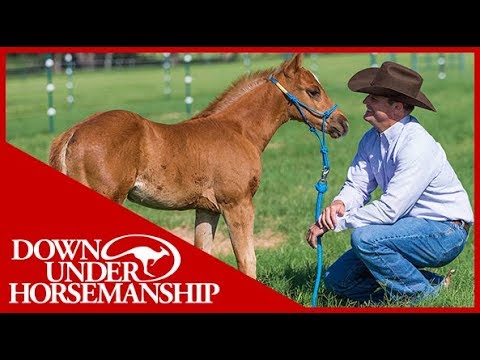
In the halter breaking session, the sequence is: approach calmly, apply gentle pressure with the halter or your hand, wait for the horse to stop moving away or lower its head, release the moment it yields, and repeat. Over multiple sessions, the horse learns that yielding is what ends the pressure — and it begins to yield more quickly and with less resistance each time.
First Handling — What to Expect
An unhandled foal or young horse will typically pull back, throw its head, or run through the pressure initially. This is normal and should not be met with force. Keep the pressure consistent and steady — not increasing in intensity — and wait. The moment the horse pauses its resistance, release. Even a microsecond of yielding is rewarded. Over multiple repetitions the horse begins to connect its own yielding with the release of pressure.
Warwick Schiller's approach to first handling emphasizes patience and working within the horse's emotional threshold. Rather than flooding the horse with pressure until it submits, he seeks the smallest possible try and rewards it immediately. This creates a horse that is mentally engaged in the process rather than simply shutting down to survive it.
Readiness for the Next Step
Your horse is ready to move on to leading when it accepts the halter being placed on and off without pulling away, stands quietly when haltered and held by the lead rope, and drops its head into the halter when offered. If any of these are inconsistent, more halter breaking sessions are needed. A horse that is confident and relaxed at this stage will progress through every subsequent groundwork step far more quickly than a horse that is rushed past it.
Watch & Learn


Want a Personalized Groundwork Plan?
Tell us about your horse and get a step-by-step training pathway matched to your situation.