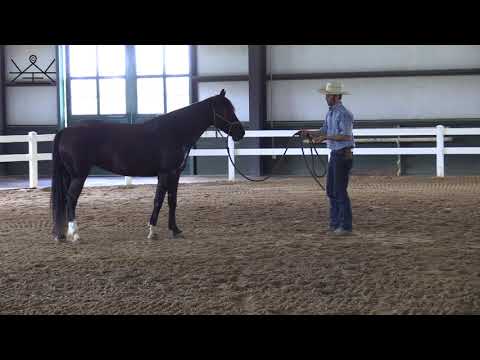
Teaching a horse to back from a raised hand signal or voice cue — without any physical contact through the lead rope — is an advanced expression of the backup that demonstrates the horse has truly internalized the concept of backing rather than simply responding to rope pressure. It is also practically useful for backing a horse at liberty, backing at a distance, or cuing a backup from the saddle using a familiar ground-trained signal as a bridge.
The process begins from an established physical backup cue. Once the horse backs reliably and promptly from rope pressure, introduce the hand signal or voice cue immediately before applying the rope pressure — signal first, then rope pressure if the horse does not respond to the signal alone. Over many repetitions, the horse begins to associate the signal with what follows and starts to move backward in response to the signal before the rope pressure arrives.
The voice cue most commonly used is a drawn-out back or step back spoken in a low, slow tone — the prosody of the word matters as much as the word itself, because horses read tone and rhythm rather than the linguistic content of spoken commands. A slow, descending tone signals backing, while a sharp ascending tone signals forward movement in most training systems.
The raised hand signal works because the horse reads the handler's body language and has learned to move away from directed energy. A hand raised and pointed toward the horse's nose, combined with the handler taking a step toward the horse, applies spatial pressure that the horse has learned means move backward. Once this spatial pressure alone produces a backup, the backup is truly established as a concept the horse understands rather than a reflex response to rope pressure.