Why Saddle Fit Is the Single Most Important Equipment Issue
An ill-fitting saddle is the most common undiagnosed cause of behavioral and training problems in horses. Bucking, rearing, reluctance to go forward, cold-backed behavior, head-tossing, refusals at fences, asymmetric movement, sensitivity to grooming along the back, and resistance to mounting can all have saddle fit as their root cause. Before attributing any of these problems to training failure, soundness issues, or temperament, the saddle must be evaluated by a qualified fitter.
Saddle fit is not a one-time event. As a horse's muscle condition changes with training, age, season, and workload, the saddle that fit correctly six months ago may no longer fit today. Annual or semi-annual professional fitting checks are minimum best practice for any horse in regular work.
Signs Your Saddle Does Not Fit — On the Ground
Tree Width (Most Critical Check)
The tree is the internal rigid frame of the saddle, and its width at the pommel is the single most critical fit dimension. A tree that is too narrow pinches the trapezius muscles and the top of the withers, creating a sharp, constant pressure that is acutely painful under rider weight. A tree that is too wide allows the pommel to drop and the tree points to dig into the shoulder muscles. Neither can be corrected with pads.
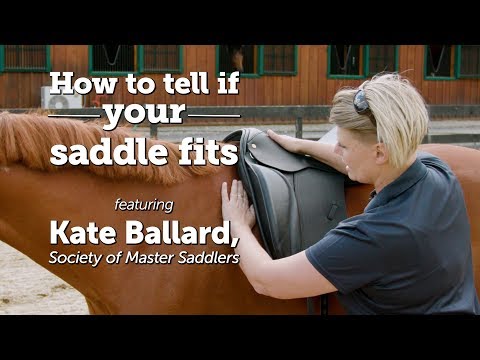
To check tree width: place the saddle on the horse's back without a pad, with the girth hanging loose. The gullet (the channel running the length of the underside of the saddle) must maintain three to four fingers of clearance over the withers and spine at all times — with the saddle empty and with rider weight. Slide your hand under the pommel alongside the horse's shoulder: you should feel even, moderate contact along the entire length of the tree point. If you feel a hard edge digging in near the top, the tree is too narrow.
Balance
The deepest part of the seat (the twist) should be level or very slightly lower than the cantle. If the pommel is notably higher than the cantle, the saddle is tipping the rider backward, creating a chair seat and placing undue weight on the horse's loins. If the cantle is lower than the pommel, the rider is tipped forward onto the horse's shoulders. View the saddle from the side with a rider in position — the spine of the saddle should run parallel to the horse's topline.
Panel Contact
The panels (the padded underside of the saddle) must make even, continuous contact with the horse's back from front to back and side to side. Uneven contact creates pressure points. Lay the saddle on the horse without a pad and feel under the panels — any rocking, bridging (contact only at the front and rear with a gap in the middle), or twist to one side indicates a fit problem.
Wither Clearance
With the rider mounted, there must be at least three finger-widths of clearance between the pommel and the horse's withers. Saddles that appear clear when empty often contact the withers under rider weight. Have a knowledgeable person check clearance both when you are sitting still and when you are posting at the trot.
Signs Your Saddle Does Not Fit — Under Saddle
Cold-backed behavior (bucking or stiffness in the first few minutes of work that disappears as muscles warm) is a classic sign of saddle pressure. A horse that is consistently sore behind the withers or along the lumbar region after work has a saddle problem until proven otherwise. Asymmetric sweat patterns under the saddle — areas of dry skin surrounded by sweat, or one side consistently wetter than the other — indicate uneven pressure distribution. Muscle atrophy (hollows or white hairs) along the back, particularly at the front of the panels, signals chronic, progressive pressure damage.
Western vs. English Saddle Fit
Western Saddles
Western saddles use a rigid tree and rigid bars that follow the horse's back contour. Trees come in gullet widths typically described as narrow (less than 6 inches), regular/medium (6–6.5 inches), wide (6.5–7 inches), and extra wide (over 7 inches). Quarter Horse bars and Semi-Quarter Horse bars refer to the angle of the bars, not just width. Many stock horses fit best in Full Quarter Horse bars or wider. The back of the skirt should not extend past the horse's last rib — a saddle that is too long for the horse's back creates pressure on the loins, which have no rib support.
English Saddles
English saddle fit is evaluated primarily through gullet plate width and tree angle. Many modern English saddles have adjustable gullet plates that allow the fitter to change tree width without replacing the saddle. English saddle trees are typically described in finger-width measurements of the front arch: narrow, medium/regular, wide, and extra wide. The panels must follow the horse's back contour without bridging, and the flap must be appropriately sized for the rider's leg length and thigh angle.
When to Call a Certified Saddle Fitter
A certified saddle fitter (look for EFTA, MSFD, or equivalent credentials) should be consulted: when buying a new saddle; when a horse's topline changes significantly; when any of the behavioral signs above appear; after a significant change in the horse's weight or muscle condition; and when a horse is in regular hard work at least annually. A fitter can assess not only static fit but dynamic fit — how the saddle moves with the horse in motion — which is not assessable from ground inspection alone.
Watch & Learn



Need More Help?
Get a personalized plan or find a trainer near you.